
Kids Golf Lessons: How to Start Kids the Right Way in Golf
If you're searching for kids golf lessons, you're probably trying to answer a few important questions:
What is the best way for kids to start golf?
How do you know if a program is right for your child?
What should junior golf lessons actually look like?
At BB Golf Academy, we believe one of the most important things in junior golf development is matching the challenge level to the skill level of the player.
When that challenge is right, kids stay motivated, confident, and excited to keep improving.
When it's wrong, they often become frustrated and lose interest in the game.
Why Traditional Kids Golf Lessons Often Fail
Many traditional golf programs introduce kids to the game the same way adults learn golf.
Kids start from the full tee box, attempt to play full-length holes, and quickly discover that the game feels extremely difficult.
Imagine a young golfer needing 10 shots just to get the ball in the hole.
That experience can feel discouraging and overwhelming.
A great way to think about this is with another sport.
In basketball, you wouldn't take a 4-year-old and ask them to shoot on a 10-foot hoop.
Instead, you lower the hoop so they can actually get the ball in the basket.
Golf should work the same way.
The environment should be adjusted so the player can experience success while still being challenged.
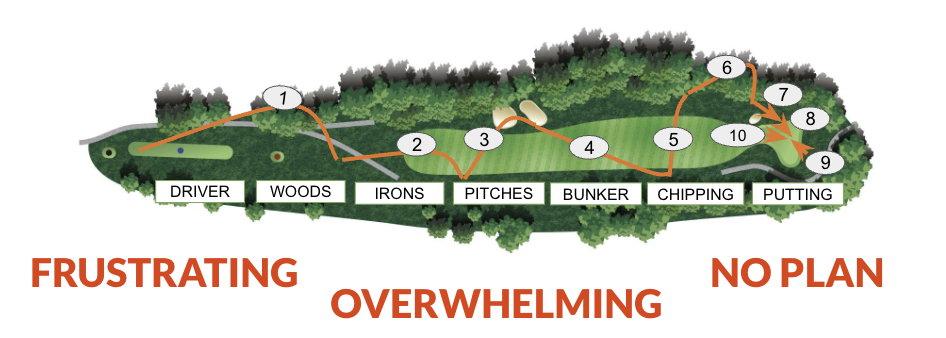
The old way of juniors learning to play the game.
The Best Way for Kids to Learn Golf
At our academy, we approach kids golf lessons differently.
Instead of starting from the full tee box, we shrink the golf course.
Players begin closer to the hole and gradually work their way back as they improve.
For example:
Level 1 players start 25 yards from the hole
Their goal is to shoot 36 or better for 9 holes
Once they accomplish that goal, they move farther away
This approach keeps the challenge achievable but still rewarding.
Kids still have to work for their success, but they aren't overwhelmed by the difficulty of a full-length golf course.
As they improve, the course gradually becomes longer and the challenge increases.
This progression keeps players motivated and helps them build confidence as they learn.
The Importance of the Right Challenge Level
One of the most important elements of effective kids golf lessons is what coaches call the challenge point.
The challenge should be:
Difficult enough to push the player
Achievable enough to create confidence
If something is too easy, kids get bored.
If something is too hard, kids get frustrated.
When the challenge is just right, kids stay engaged and excited to improve.
This is one of the biggest reasons we structure our junior program the way we do.
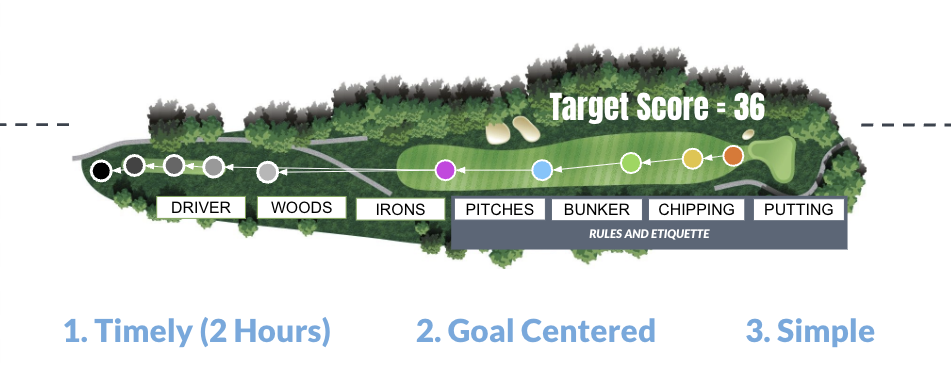
The right way to learn the game
How Our Junior Golf Academy Grows With the Player
One of the biggest improvements we've made to our junior program is changing the academy so that the program grows as the player develops.
In the past, many junior golf programs simply had players attend one class per week, regardless of their skill level.
But as we studied junior development, we realized something important:
The players who improve the most are the players who show up more often.
Just like any other sport, improvement comes from practice, coaching, and competition.
So we designed our academy to increase those elements as players progress.
What Kids Golf Lessons Look Like at Each Level
Our junior academy is structured around multiple development levels.
Each level increases the amount of:
coaching
playing
practice
commitment
Level 1 and Level 2
Players begin with a strong foundation.
At these levels, students typically have:
4 coaching sessions per month
2 playing rounds per month
1 hour of self-practice per week
The focus is on fundamentals and learning how to play the game.
Level 3
Once players progress to Level 3, the commitment increases.
At this stage, players typically have:
8 coaching sessions per month
3–4 rounds per month
2 hours of self-practice per week
This is where development really begins to accelerate.
Players are now spending significantly more time working on their game.
Levels 4, 5, and 6
As players continue to improve, the academy becomes even more structured.
At these levels, players may have:
12 coaching sessions per month
3–8 rounds of golf per month
3–4+ hours of self-practice per week
At this point, the player is becoming highly committed to improving.
And that's exactly what leads to long-term development.
Why More Reps Lead to Better Golfers
Think about any other youth sport.
In soccer, young players might start with:
one practice per week
one game per week
But as they grow and improve, they begin practicing more often and playing more games.
That's how skill development works.
Golf is no different.
The players who:
practice more
play more
receive more coaching
are the players who improve the fastest.
Our academy is simply structured to reflect that reality.
How We Structure Our Kids Golf Lessons
Another key part of our program is the coach-to-student ratio.
At beginner levels, students don't need extremely detailed technical instruction.
They mainly need:
solid fundamentals
clear instruction
repetition
Because of that, beginner classes can have a slightly larger group size.
For example:
Level 1 classes may include 10 students with 2 coaches.
As players move up, the ratio becomes smaller so that players receive more personalized coaching.
Higher levels of development require more attention to detail, which is why those classes have fewer students per coach.
What Happens After Level 6?
After players complete Level 6, there are additional levels that can take them all the way to playing from the full tee box.
At that point, we work closely with families to determine the best path forward.
Some players may continue with:
small group coaching
Others may move into:
private coaching
tournament preparation
competitive development plans
Every player’s journey is different, and we help families build the right plan for their goals.
What to Look For When Searching for Kids Golf Lessons
If you're researching kids golf lessons, here are a few things to look for in a junior program.
A good program should include:
A development pathway
Opportunities for kids to play on the course
Structured coaching sessions
Clear progression through levels
A system that grows with the player
These elements help ensure that your child is learning golf in a way that is both fun and effective.
Helping Kids Develop a Love for the Game
Our goal isn't just to teach kids how to swing a golf club.
It's to help them develop:
confidence
patience
discipline
a lifelong love for the game
When junior golfers are introduced to golf the right way, they stay engaged and excited to keep improving.
And that's what great kids golf lessons should ultimately do.
WANT TO GET YOUR KIDDO STARTED WITH THE GAME?
If you're searching for kids golf lessons, our BB Golf Academy Junior Program is designed to help young golfers start the game the right way and progress step by step as they develop.
Our academy provides:
structured coaching
on-course playing opportunities
a clear development pathway
a supportive environment for junior golfers
You can learn more about our Junior Academy program and how to get started by visiting our Junior Academy page.
